
Healthy Meal Planning Strategies Without the Overwhelm
What's the biggest point of overwhelm for you when it comes to feeding your family?
For me, it's never been the cooking itself—it's the planning and getting the groceries.
Being in the kitchen is actually a therapeutic space for me. Chopping vegetables, stirring a pot of soup, or putting together a simple meal helps me slow down and be present. I know that's not true for everyone, and that's okay. Whether you love cooking or simply see it as another task on the never-ending to-do list, I'm here to make the entire process easier—and dare I say, enjoyable.
Let's break it down and simplify each step.
The Hidden Cost of Meal Planning: Decision Fatigue
Most people think meal planning is about food.
I think it's about decisions.
As parents, we're already making hundreds of decisions every day. We're managing schedules, appointments, activities, schoolwork, household responsibilities, and everything in between. By the time dinner rolls around, many of us aren't lacking recipes—we're lacking mental energy.
One study found that people who regularly plan meals tend to have healthier dietary patterns and greater food variety compared to those who don't. But what often gets overlooked is why meal planning works. It's not simply because we have a plan—it's because we've reduced the number of decisions we have to make throughout the week.
When every meal requires searching for recipes, creating a new grocery list, and buying unique ingredients, healthy eating can quickly become overwhelming.
That's why I stopped asking myself, "What should I make for dinner?" and started asking, "What protein am I working with this week?"
One question. Endless possibilities.
The Strategy That Changed Everything
A few years ago, I realized I was spending far too much time researching recipes, creating detailed grocery lists, and buying ingredients for meals I would only make once.
Every week felt like starting over.
I'd save recipes with the best intentions, purchase specialty ingredients, and then find myself scrambling again a few days later wondering what to make for dinner.
Eventually, I decided there had to be a simpler way.
At the beginning of each month, I started buying most of our meat in bulk. Then each week, I thaw one or two proteins and build our meals around them.
Instead of shopping for recipes, I started shopping for ingredients.
My weekly grocery trips became focused on fresh produce, fruit, grains, dairy products, and the random staples we'd run out of.
The result?
Less time planning.
Less time shopping.
Less food waste.
And significantly less mental clutter.
Why Planning Around Protein Works
Protein becomes the anchor of the meal.
Once the protein is decided, the rest of the meal usually falls into place.
For example, if I roast a batch of marinated chicken thighs at the beginning of the week, those same chicken thighs can become:
Chicken tacos
Loaded salads
Quesadillas
Chicken soup
Chicken pot pie
Chicken and dumplings
Enchiladas
The same concept works with other versatile proteins:
Meatballs
Steak bites
Grilled chicken tenders
Salmon bites
These proteins not only create easy dinners but also make excellent grab-and-go lunches throughout the week.
One protein can create multiple meals without requiring multiple recipes.
That's where the magic happens.
Build the Plate, Not the Perfect Recipe
One of the biggest mindset shifts for me was moving away from recipe-based planning and toward plate-based planning.
Instead of asking:
"What recipe should I make?"
I started asking:
"What protein, vegetable, and grain can I put on the plate?"
This simple framework dramatically reduced my mental load.
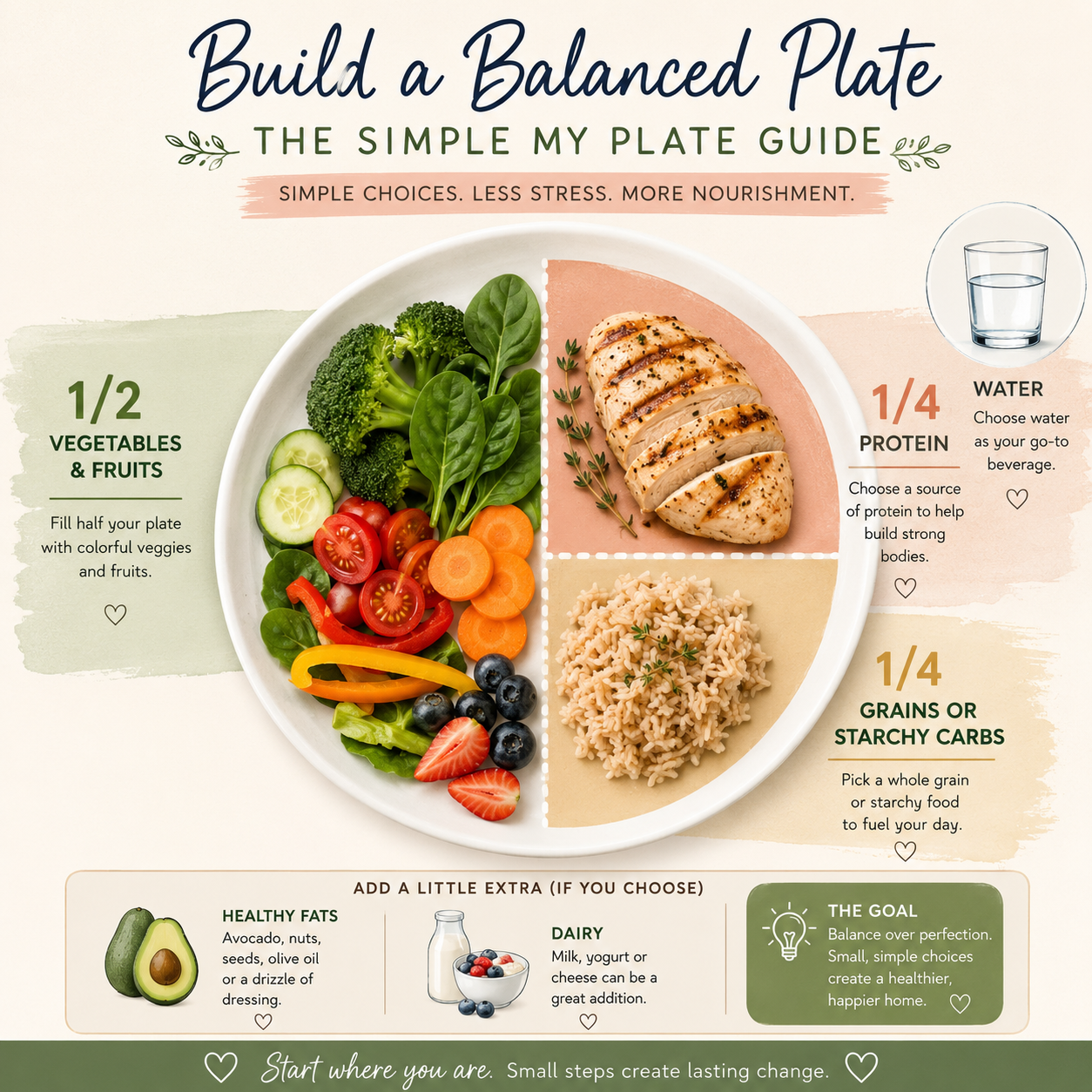
The Simple Plate Formula
Make it stand out
Half the Plate: Vegetables and Fruit
One Quarter: Protein
One Quarter: Whole Grains or Starchy Carbohydrates
Optional: Healthy fats such as avocado, olive oil, nuts, seeds, or dressing
When you use this formula, meals don't have to be complicated.
A balanced meal might look like:
Steak bites, roasted broccoli, and sweet potatoes
Salmon, rice, and asparagus
Meatballs, green beans, and roasted potatoes
Chicken thighs, salad, and quinoa
That's it.
No elaborate recipe required.
This approach aligns with the USDA MyPlate model, which encourages building meals around balanced portions of vegetables, fruits, proteins, and grains. The beauty of this framework is that it removes the pressure to create something new every night while still supporting overall nutrition.
Why This Approach Reduces Overwhelm
One of the biggest benefits of this strategy isn't saving time in the kitchen.
It's reducing the mental load that comes with feeding a family.
When you simplify your system, you naturally eliminate:
Hours of recipe research
Endless scrolling for meal inspiration
Complicated grocery lists
Specialty ingredients you rarely use again
Last-minute dinner stress
Decision fatigue
Instead of wondering what to make every night, you already know your options.
Your ingredients overlap.
Your grocery list becomes predictable.
Your meals become easier.
And healthy eating becomes more sustainable.
A Healthy Family Starts With a Supported Parent
This lesson extends far beyond meal planning.
One thing I've learned throughout my wellness journey is that taking care of my family starts with taking care of myself.
When I'm overwhelmed, stressed, and constantly trying to do everything perfectly, healthy habits become harder to maintain.
Simplifying meal planning wasn't just about getting dinner on the table.
It was about creating more capacity.
More energy.
More peace.
More room for the things that matter most.
As parents, we often focus so much on caring for everyone else that we forget our own wellness matters too.
But the truth is that the well-being of a family often reflects the well-being of the people leading it.
When parents reduce stress, simplify routines, and prioritize their own wellness, they're better equipped to create a healthy environment for their families.
Family wellness doesn't start with a perfect meal plan.
It starts with a parent who has the capacity to show up consistently.
Start Where You Are
If meal planning feels overwhelming right now, don't worry about creating the perfect system.
Choose one protein.
Buy a few vegetables.
Pick a grain or starchy carbohydrate your family enjoys.
Build simple meals from there.
Remember, healthy eating doesn't require perfection.
It requires consistency.
Small changes practiced over time create meaningful results.
Start where you are.
Keep it simple.
And trust that those small, intentional choices are helping build a healthier home for you and your family.
Sources & Further Reading
The strategies shared in this article are rooted in both personal experience and evidence-based nutrition guidance. If you'd like to learn more, these resources are a great place to start:
Meal Planning and Health Outcomes
Ducrot, P., Méjean, C., Aroumougame, V., Ibanez, G., Allès, B., Kesse-Guyot, E., Hercberg, S., Péneau, S. (2017). Meal planning is associated with food variety, diet quality and body weight status in a large sample of French adults. International Journal of Behavioral Nutrition and Physical Activity, 14(12).
https://ijbnpa.biomedcentral.com/articles/10.1186/s12966-017-0461-7
This study found that individuals who planned meals were more likely to have healthier diets, greater food variety, and lower odds of obesity.
USDA MyPlate
U.S. Department of Agriculture. MyPlate.
https://www.myplate.gov
MyPlate provides a simple visual framework for building balanced meals using fruits, vegetables, grains, protein foods, and dairy.
Dietary Guidelines for Americans
U.S. Department of Health and Human Services & U.S. Department of Agriculture. Dietary Guidelines for Americans, 2020–2025.
https://www.dietaryguidelines.gov
These guidelines provide science-based recommendations for healthy eating patterns across all stages of life.
Decision Fatigue and Simplifying Choices
Baumeister, R. F., Vohs, K. D., & Tice, D. M. (2007). The Strength Model of Self-Control. Current Directions in Psychological Science, 16(6), 351–355.
Research suggests that repeated decision-making throughout the day can contribute to mental fatigue, making simple systems and routines valuable tools for reducing overwhelm.
A Note from Me
While every family is different, I've found that simplifying meals around versatile proteins, balanced plates, and repeatable systems helps reduce stress and create more space for what matters most. My hope is that these strategies help you spend less time worrying about food and more time enjoying life with your family.