
When Overwhelm Becomes the Loudest Voice
"Peace isn't something we find. It's something we learn to cultivate."
There are days when my mind feels like a pinball machine.
Between building a business from the ground up, learning an entirely new world of content creation, homeschooling my seven-year-old, potty training my two-and-a-half-year-old, planning summer camps, packing for vacations, keeping up with laundry, preparing meals, and trying to remember whether I actually switched the clothes from the washer to the dryer... my thoughts rarely move in a straight line.
They bounce.
From one responsibility to another.
From one unfinished task to the next.
My grocery list suddenly reminds me that I forgot to respond to an email. The email reminds me I need to film a video. The video reminds me I need to finish editing a blog. Before I know it, I'm standing in the kitchen wondering why I walked in there in the first place.
And, of course, I have a toddler…
If you've ever lived with a toddler, you know that every quiet moment has the potential to become an emergency. One minute they’re happily playing, and the next they’re standing on the kitchen table wearing rain boots and asking for a snack while you're trying to figure out what happened to the last five minutes.
Motherhood has taught me many things.
One of them is that overwhelm doesn't always arrive because we're doing something wrong.
Sometimes it arrives because we're carrying a lot.
For a long time, I believed I simply needed better time management.
If I could become more organized...
If I could wake up earlier...
If I could create the perfect schedule...
If I could anticipate every need before it happened...
Then surely I would finally feel calm.
I thought peace would come from having a plan for everything.
But motherhood has a way of showing us that life cannot always be planned.
Children get sick.
Plans change.
Emotions rise unexpectedly.
The day you carefully mapped out can unravel before breakfast.
And somewhere along the way, I realized something important:
I wasn't actually looking for better time management.
I was looking for more flexibility.
Learning to Bend Instead of Break
One of the biggest lessons motherhood has taught me is that expecting less perfection from myself made room for more peace.
I stopped trying to plan every moment, every outcome, and every reaction.
I learned to leave space for the unexpected.
Because the truth is, life will always bring unexpected moments. The question is not whether we can prevent them.
The question is whether we can learn to move through them with grace.
I often think about the trees I see when I'm outside.
Even the strongest, tallest trees bend in the wind.
They don't resist every gust.
They don't break because the weather changes.
They have strength because they have flexibility.
And I think we are much the same.
Strength doesn't mean we never struggle.
Strength means we learn how to bend without losing ourselves.
When I became more flexible, something changed.
I noticed I reacted less.
I gave myself and my children more patience.
I created more room for connection.
I stopped spending so much energy trying to control moments that were never meant to be controlled.
And that realization became one of the most important parts of my wellness journey:
Sometimes the path to peace isn't creating more control.
Sometimes it's learning how to let go.
Why Overwhelm Feels So Loud
One of the most comforting things I've learned is that overwhelm isn't a sign that we're failing.
It's often a sign that our brain is doing exactly what it was designed to do.
Our brains are constantly scanning our environment, prioritizing what feels urgent, important, or potentially threatening.
When too many demands compete for our attention at once, our nervous system can shift into a protective state that makes it harder to think clearly, regulate emotions, or make thoughtful decisions.
Have you ever walked into a room and completely forgotten why you were there?
Or found yourself rereading the same sentence three times because your thoughts kept drifting?
Or snapped at someone you love, only to immediately wish you could take your words back?
You're not failing.
You're human.
When we are overwhelmed, our attention naturally narrows toward whatever feels most pressing. This response is incredibly helpful when we are facing true danger.
But modern life often asks our brains to respond to hundreds of small stressors at once.
The laundry.
The schedule.
The notifications.
The responsibilities.
The emotional needs of everyone around us.
No wonder so many of us feel mentally exhausted.
The Quiet We Keep Waiting For
There are many evenings when the first real moment of silence doesn't come until after my girls are asleep.
The toys have been picked up.
The dishes are finally done.
The house grows still.
Sometimes I lay back in a hot bath and realize it's the first moment all day that I've actually heard my own thoughts.
For a long time, I believed I had to wait for those quiet moments before I could feel regulated.
But I've slowly learned something different.
Calm doesn't always arrive when life becomes quiet.
Sometimes we have to create small moments of quiet within the noise.
Not an hour.
Not even fifteen minutes.
Sometimes thirty seconds is enough.
Thirty seconds to pause.
Thirty seconds to breathe.
Thirty seconds to notice that we are here.
And that small pause can change the way we move through the rest of the day.
The Science Behind the Moment
Researchers have spent decades studying the relationship between stress, attention, and emotional regulation.
When we experience stress, our bodies and brains work together to help us respond. This system is protective and necessary, but when we remain in a heightened state for long periods of time, it can become harder to focus, think clearly, and respond intentionally.
This is why practices that bring us back into the present moment can be so valuable.
Mindfulness practices—which involve intentionally bringing awareness to our thoughts, emotions, and surroundings without judgment—have been studied for their potential role in reducing perceived stress and supporting emotional regulation.
Mindfulness does not remove our responsibilities.
It does not make difficult seasons disappear.
Instead, it creates a small space between what happens and how we respond.
And sometimes, that space is where our greatest growth happens.
Because reacting happens automatically.
Responding happens intentionally.
And sometimes the bridge between the two is surprisingly small.
It might be one slow breath.
It might be stepping outside.
It might be noticing the feeling of your feet on the ground.
Or it might be something as simple as reconnecting with your senses.
Your Mindful Moment Practice
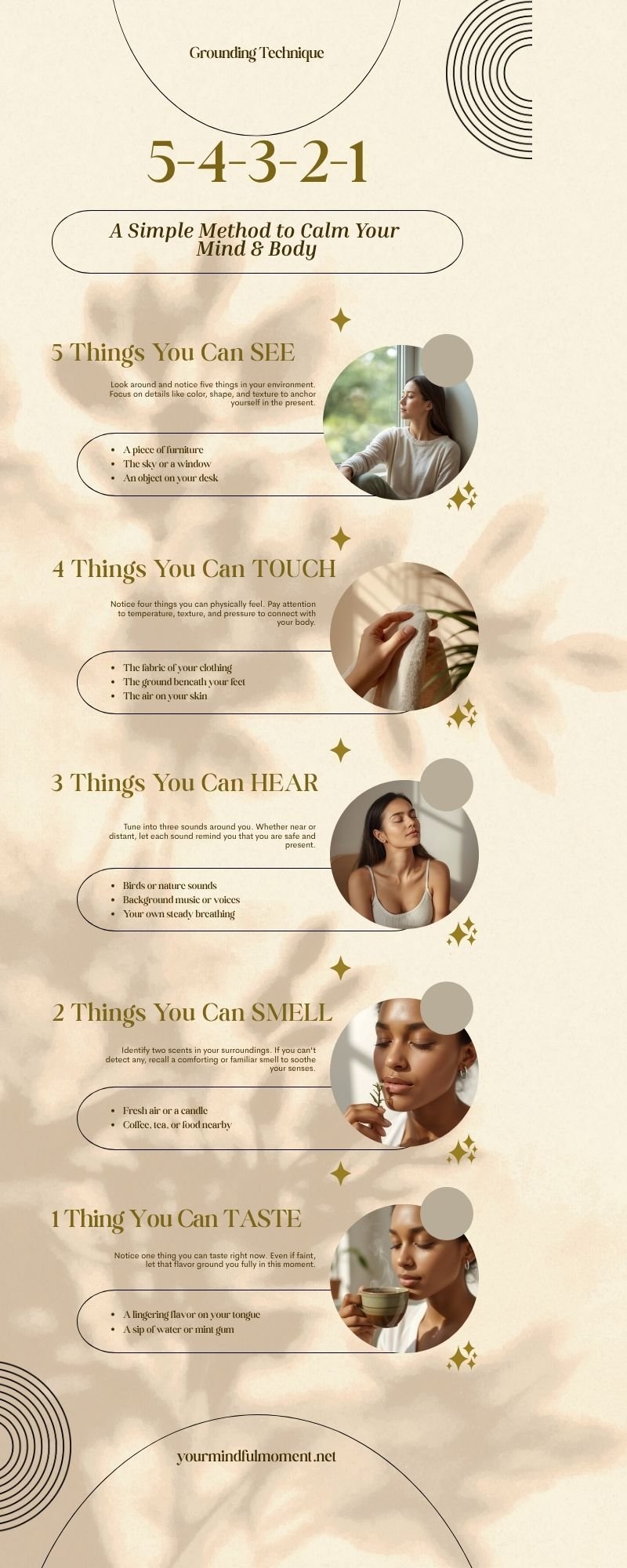
When overwhelm becomes the loudest voice, try returning to the present moment through the 5-4-3-2-1 grounding technique.
Pause.
Take a breath.
Then notice:
5 things you can see.
Look around and name five things in your environment.
4 things you can feel.
Notice textures, temperatures, or sensations.
3 things you can hear.
Listen for sounds around you.
2 things you can smell.
Notice any scents nearby.
1 thing you can taste.
Bring awareness to a flavor or sensation.
This practice is not about making stress disappear.
It is about reminding your mind and body:
"I am here. I am safe. I can take the next step."
Finding Your Way Back
The goal of wellness is not to create a life where nothing goes wrong.
That life doesn't exist.
The goal is to build the awareness, patience, and flexibility to meet life as it comes.
Like the trees that bend in the wind, we can learn that strength and softness can exist together.
We can be grounded while still being flexible.
We can be strong while still needing rest.
We can love our families deeply while still making space for ourselves.
And we can take one small moment at a time.
Because peace isn't something we find when life finally becomes easy.
Peace is something we practice in the middle of it all.
Your Mindful Moment
This week, I invite you to ask yourself:
“Where am I trying to create control when I really need flexibility?”
Is there a place where you could loosen your grip?
A place where you could allow more patience?
A moment where you could pause before responding?
Remember:
Even the strongest trees bend in the wind.
Your strength is not measured by how much you can carry without moving.
Your strength is found in your ability to adapt, grow, and return to yourself.